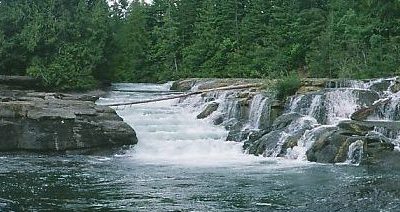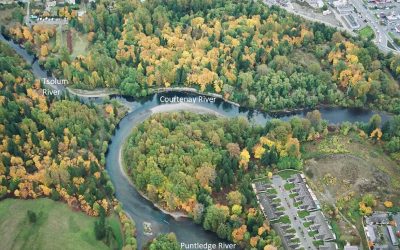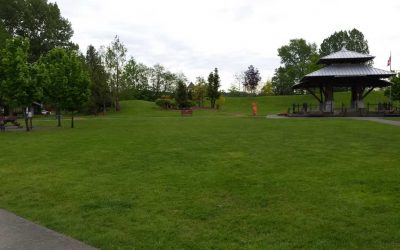
Puntledge River-related posters with information about salmon, salmon habitat and habitat restoration.
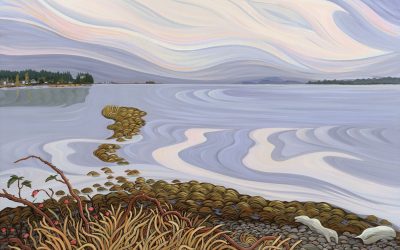
Comox Harbour Fish Trap Photo Gallery
Such contemporaneous, large-scale fishing activity at multiple locations in the estuary could have resulted in the capture of enormous quantities of fish.
Highlights from the Ancient Fish Trap Study
Two temporally and morphologically distinct trap types were utilized, and the shift from the Winged Heart trap type to the Winged Chevron trap type about 700 years ago appears abrupt and closely coincident with Little Ice Age climatic conditions and increased importance of salmon at Aboriginal village sites on west coast Vancouver Island, at Haida Gwaii (Queen Charlotte Islands) and south coast Alaska.
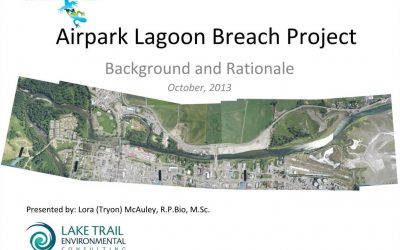
Airpark Lagoon Breach Project Background and Rationale
Slide Show – Presented by Lora (Tyron) McAuley, R.P.Bio, M.Sc.
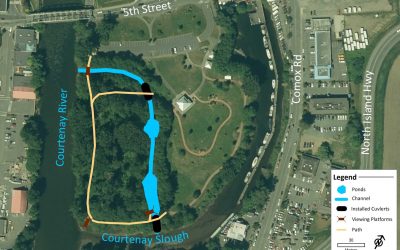
Simms Millennium Park Habitat Enhancement
When Simms Millennium Park opened in 2000 it included off channel habitat for fish and other riparian species. This was one of only three off-channel habitats for juvenile salmonids along a three km stretch of the upper ecotone of the K’ómoks Estuary.
Resident Geese Overgraze
These resident geese overgraze the vegetation and grub the roots of the ‘marsh platform’ – a thick accumulation of nutrient-dense soils from land, freshwater aquatic and marine sources bound together by vegetation.
The KFN Guardians are preventing rich soils from being eroded
By reviving cultural practices and innovating restoration techniques, the Guardians are preventing rich soils from being eroded and washed away with the tides.
Near the Waters Edge; A Green Infrastructure Tour
Guided walking and kayaking tours showcasing green infrastructure in and around the Courtenay River were held on May 10 and 11, 2019. The tours were geared towards increasing political awareness of the possibilities of green infrastructure. Participants visited areas where green infrastructure was already in place or where it could be implemented in the future.
Guardians Building Resiliency in the K’ómoks Estuary
[av_image src='https://projectwatershed.ca/wp-content/uploads/2018/10/Goose-Exclusion-Fencing-web2.jpg' attachment='12180' attachment_size='full' align='center' styling='' hover='' link='' target='' caption='' font_size='' appearance='' overlay_opacity='0.4'...
Ancient Fish Traps
A large scale, technologically sophisticated intertidal fishery in Courtenay, British Columbia. The information on this page comes from Comox Valley Archaeologists Nancy Greene and David McGee. While it is not a Project Watershed project, we proudly support this body of work.
Groundbreaking Archeology Celebrated!
Nancy Greene and David McGee, local archeologists and Comox Valley residents, are going to be speaking at the upcoming K'ómoks Estuary Seafood Dinner. Their groundbreaking research The Comox Harbour Fish Trap Complex: A Large-Scale, Technologically Sophisticated...
Stephen Hume: Archeology student publishes paper on ancient, industrial-scale First Nations fishery
England’s monarchs were sacrificing to Woden and persecuting Christian missionaries when First Nations managed a vast, highly-productive, industrial-scale fish harvesting complex in the estuary of the Courtenay River.
At first, the elaborate arrangement of 300 ingenious traps on the sandy flats of the river mouth harvested herring, which still mass to spawn off the east coast of Vancouver Island every March.
But 700 years ago, perhaps in response to climate change, the technology was altered to exploit pink, chum, coho, chinook and possibly sockeye salmon.